
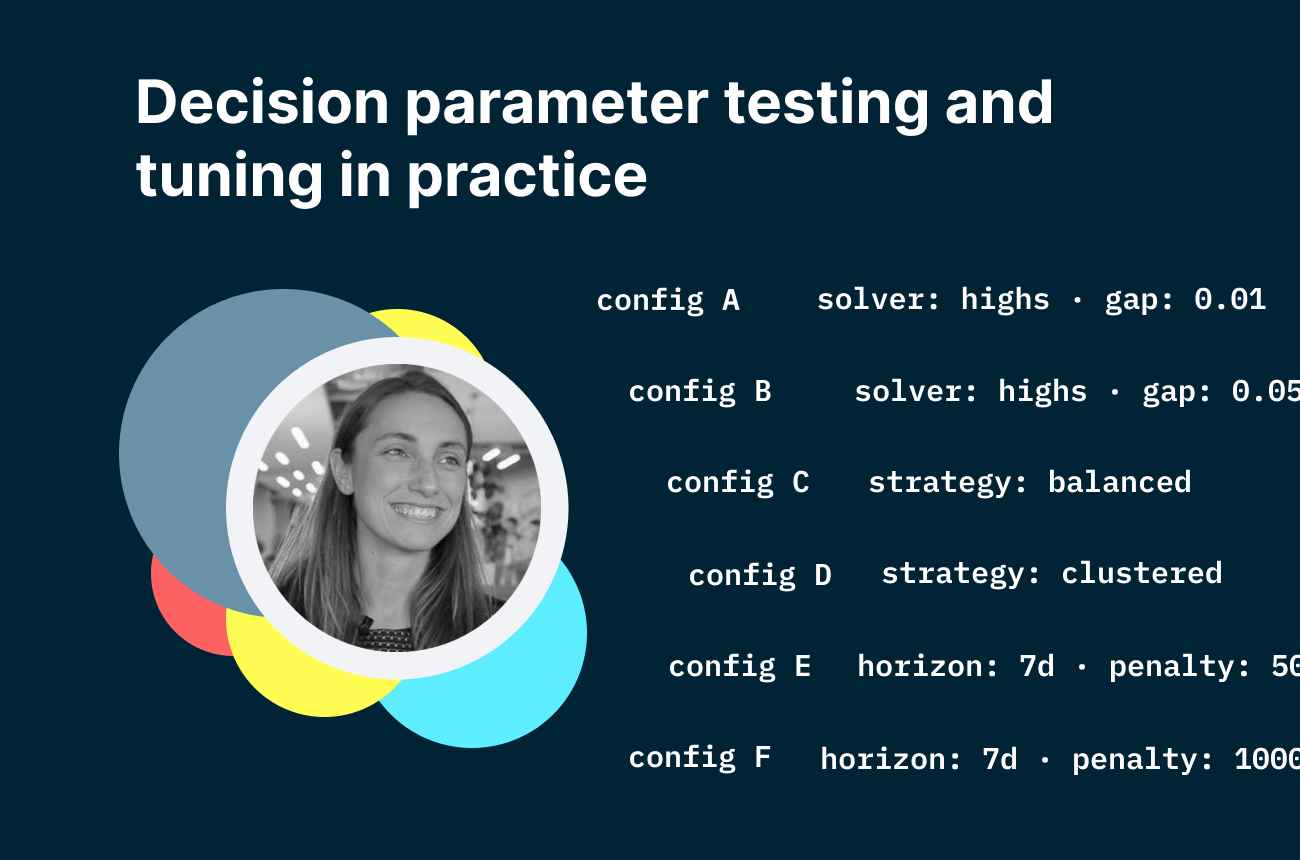
How confident are you in your decision model parameters? How optimized are your decision model's parameters? Learn how to systematically sweep and test and auto-select the best result per request.

Follow us on LinkedIn and subscribe to our LinkedIn newsletter.


Learn how to use Nextplot to visualize points, routes, and more on a map.

Learn how to build, test, and deploy Pyomo mathematical optimization models faster with Nextmv, featuring pre-bundled solvers for CBC and GLPK. Create a new model or integrate an existing one to accelerate its development with DecisionOps tooling.

Use Nextmv to compare two decision models operating in production while accounting for network effects

Switchback testing is a key part of the DecisionOps workflow. Get a quick primer on what it is and when to use it in this 2-minute video.

Learn how to solve mixed integer programming (MIP) problems with Google’s OR-Tools for use cases like scheduling, order fulfillment, packing and more. Then promote an updated model to production using CI/CD.

Automating on-demand logistics operations for scale, customization, and iteration is easier than you might think. Learn how to build, test, and deploy models for demand forecasting, shift scheduling, and route creation.
.png)
Learn how to integrate a new or existing OR-Tools model into production systems using Nextmv and its infrastructure, testing capabilities, and collaboration features to create a repeatable workflow to production.

With the Nextmv Shift Scheduling app, you can start automating shift scheduling decisions in minutes.

Launch your OR-Tools model into production as a decision microservice with a simple copy/paste in Python using the Nextmv OR-Tools integration.

How do you feel about the decision model updates you ship to production? Acceptance and shadow testing are two ways to gain confidence across model performance for business KPIs and stability indicators. We’ll show you how.

Test two order fulfillment algorithms that consider costs for distribution center handling costs and carrier selection. A new algorithm introduces a change to account for inventory capacity at a distribution center to increase efficiency and decrease food waste. How will costs change compared to the algorithm that does not?

See how to test two VRP decision algorithms (one that has a homogenous fleet of cold chain-ready vehicles and one that is a mixed fleet with cold chain and non-cold chain vehicles) that looks to compare total time on road values and other KPIs.


